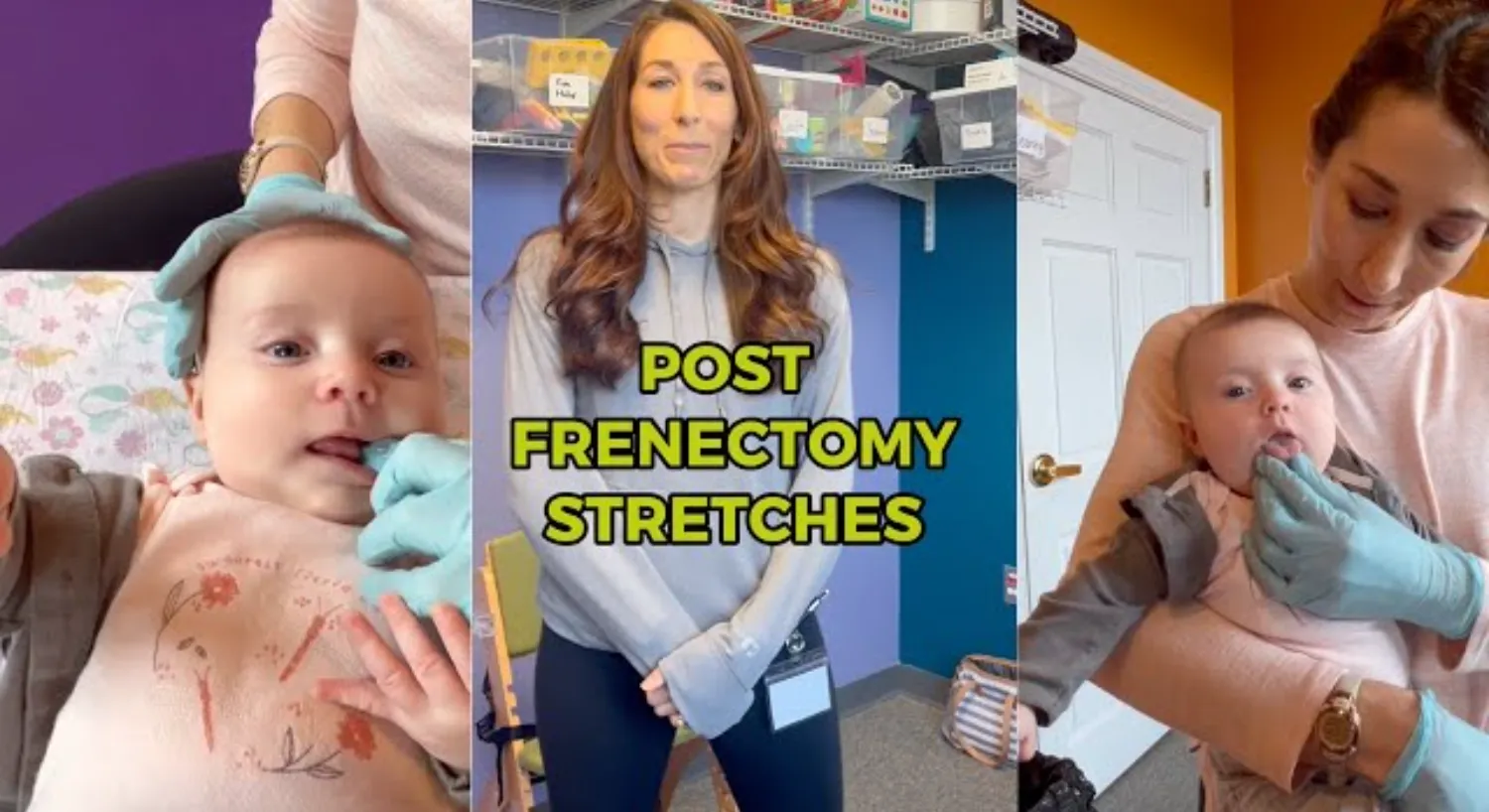
Post Frenectomy Care

smiling baby looking at the camera sticking her tongue out

What is a Frenectomy?

A frenectomy is a minor surgical procedure involving the removal or modification of a frenulum, a small fold of tissue that prevents an organ in the body from moving too far.

Frenectomy Care

Follow Post-Op Instructions:

  • Adhere strictly to the post-operative care instructions provided by your healthcare provider.

Pain Management:

  • Use recommended pain relief medications as directed.
  • Apply cold compresses to reduce swelling and discomfort.

Oral Hygiene:

  • Keep the area clean to avoid infections. Gently rinse the mouth with a saline solution as advised.
  • Avoid using mouthwash with alcohol as it can irritate the surgery site.

Dietary Adjustments:

  • Stick to soft foods and avoid hot, spicy, or acidic foods that may cause irritation.
  • Ensure adequate fluid intake to stay hydrated.

Stretching Exercises:

  • Perform any stretching exercises as recommended by the surgeon to ensure proper healing and flexibility.

Monitor Healing:

  • Keep an eye on the surgical site for signs of infection such as increased redness, swelling, or discharge.
  • Contact your healthcare provider if you notice any unusual symptoms.

Follow-Up Appointments:

  • Attend all scheduled follow-up appointments to monitor the healing process and address any concerns.

Continue Reading

May 16, 2023

What Is Intensive Feeding Therapy at MetroEHS and How Does It Work?

What is the Intensive Feeding Therapy Program Like at MetroEHS?

As we dive into the details of the Intensive Feeding Therapy Program at MetroEHS, hear from the experts at MetroEHS and how they collaborate on the most wholistic approach to Intensive Feeding Therapy.

Jessica Hunt (Occupational Therapist/Feeding Specialist):
When it comes to treating children who have complex feeding difficulties and pediatric feeding issues, there's a multitude of things that are typically at the root of the problem. So what's very unique about the program that we have here is that we have involvement from both occupational therapy, speech and language therapy, physical therapy, a dietician, as well as psychology.

Rose Britt (Registered Dietitian):
So it's all five disciplines. Spending time together with the family, with the patient, with each other, all talking at one cohesive time, making a plan instead of grabbing pieces from all over the place and putting them together. I think it makes it a lot smoother for us and the families as well.

Kris Krajewski (Director PT, OT, and Speech Services/SLP):
Each of our disciplines really does have something to offer to this process, but when we work all together, we have the ability to help our kiddos make more progress more quickly.

Kayla Daniels (Physical Therapist):
At Metro, we really take a whole body approach. We don't just look at one aspect of the child. And a lot of people don't think of physical therapy as part of the feeding team, but in order to eat, you have to use all of these posture and muscles, you have to hold yourself up. You have to hold your head up to be able to swallow. So really focusing on all of those aspects of your body is really important to be able to make the progress.

Azari Haygood (Psychologist):
As a psychologist on staff for the Intensive Feeding Program, I offer mental health services to the families and to some of the clients. It's very stressful for a lot of these families. It's stressful for the clients that we see. And so, I offer just another support for them, where I'm helping them kind of overcome some of the stressors that they're experiencing around feeding.

Rose Britt (Registered Dietitian):
It's not just me telling you what to do. There's so much more going into that, and you get to really listen to the families and hear why it's not working and problem solve together.

Kayla Daniels (Physical Therapist):
The impact you can make, not only on the child's life, but on the family's life as a whole is huge.

Azari Haygood (Psychologist):
Seeing that improvement in their family's lives feels really great all around.

Jessica Hunt (Occupational Therapist/Feeding Specialist):
One in 23 children have a pediatric feeding issue. And so, to truly be able to address all of the aspects of that in one place, that's where we get to make a difference every single day.

Kris Krajewski (Director PT, OT, and Speech Services/SLP):
It's like when you have a jigsaw puzzle and you're missing one piece, you can still tell what the picture of the jigsaw puzzle is going to be, but when you have all of the pieces together, integrated into this treatment, the result is just something so much more beautiful.

May 7, 2025

The Journey to Graduation in ABA Therapy – WDIV Segment #5

MetroEHS emphasizes that ABA therapy is not a lifelong commitment but a structured program aimed at equipping children with essential skills. From the outset, each child receives an individualized treatment plan tailored to their unique needs and developmental goals at MetroEHS Pediatric Therapy.

Dawn Sterling, Regional Director of Behavioral Health at MetroEHS, explains, “We like to think of working ourselves out of a job… it’s not necessarily a lifelong thing that you have to experience, especially for those that are in ABA therapy.” This perspective underscores the organization’s commitment to empowering children to achieve independence.

Individualized Planning and Early Intervention

The process of graduating from ABA therapy is highly individualized. Ashley Lewis, Clinical Director at MetroEHS, notes that planning for graduation begins early in the therapy process. “We like to start talking about graduation early… so that we know what goals that we want to go for and how we want to target each and every one of those goals,” she says. This proactive approach ensures that therapy is goal-oriented and progress is continuously monitored.

Early intervention is a cornerstone of MetroEHS’s philosophy. By engaging children in therapy at a young age, the likelihood of achieving developmental milestones and preparing for school increases significantly.

Life After ABA Therapy

Graduation from ABA therapy marks the beginning of a new chapter. Post-graduation, children may continue to receive support through other services offered by MetroEHS, such as speech therapy, occupational therapy, and participation in social or playgroups. These services aim to reinforce the skills acquired during ABA therapy and ensure their application across various environments .

The goal is to prepare children for success in school and beyond, fostering independence and confidence in their abilities.

Learn More About MetroEHS Services

MetroEHS Pediatric Therapy offers a comprehensive range of services designed to support children with developmental challenges. For more information about their programs and how they can assist your family, visit metroehs.com or call 248-970-8402

Embarking on the journey through ABA therapy with MetroEHS means partnering with a team dedicated to revealing the “super” in every child.

April 30, 2020

Does Online Speech Teletherapy Work

Teletherapy, also called tele-practice or tele-speech, has become more popular during the uncertain circumstances and stay at home orders of COVID-19. Teletherapy can bring a sense of familiarity in uncertain times, as your child can have a weekly live speech therapy visit with a consistent speech language pathologist (SLP). A relationship is built, and the therapist and child share smiles and laughter in between working on their goals. With teletherapy, children can continue to receive continuity of care even as they stay safe at home! But does this foreign method of attending speech therapy really work?

Research is largely in agreement: Teletherapy is a very effective way of teaching kids speech and language!

With teletherapy, speech therapy is provided via a video chat platform that is secure. MetroEHS’s online platform includes fun games, a box for clients to watch applicable videos and talk through worksheets or read stories, screen share, practice cards, and, of course,  a live-streaming video SLP guiding them through all of it. All of these features engage most children, including those on the Autism Spectrum. This 1:1 teletherapy has been proven effective: according to a review of 7 studies of school-aged children, “telehealth is a promising method for treating children” (1). Another study looking specifically at children with ASD stated, “All [14] studies reported high levels of programme acceptability and parent satisfaction with the telehealth component of the intervention” (2). And another states, “Emerging research in telepractice treatment for ASD clients already shows success in both direct and indirect interactions” (3).

If a child is too young or difficult to engage, the SLP may opt for a parent training approach. The parent will receive a list of supplies to gather from around the house, and the SLP will teach the parent how to target the child’s goals. The parent is encouraged to ask questions, and the SLP coaches as the parent engages their child and completes their goals. This has also been proven effective for children learning language! Evidence suggests, “that parent-mediated intervention training delivered remotely can improve parents’ knowledge in [autism spectrum disorder] ASD, parent intervention fidelity, and subsequently improve the social behavior and communication skills of their children with ASD (4).

Feeding Therapy can be provided with a similar model. The SLP guides the caregiver during the session, and talks through strategies and techniques for children accepting the food, chewing, and swallowing. Providing feeding therapy online can be beneficial because the SLP can see where the child typically sits, the types of eating utensils that are used, and overall family dynamic- all of which play a major role in carryover of skills to the home environment. What better way to support generalization to home, than having therapy in the home! Feeding Teletherapy, too, is an excellent and effective substitute to in-person therapy, according to research (5)!

As you can see, teletherapy is a powerful alternative to in-person therapy, especially during situations when receiving in-person therapy is difficult or impossible for families. If you would like more information about teletherapy, to enroll your child, or a free “Teletherapy Tour” to see our platform, please contact MetroEHS today!

Resources

  1. 2017. Wales, D., Skinner, L., et al. The Efficacy of Telehealth-Delivered Speech and Language Intervention for Primary School-Age Children: A Systematic Review. International Journal of Telerehabilitation, 9(1), 55-70.
  2. 2018. Sutherland, R., Trembath, D., et al. Telehealth and Autism: A Systematic Search and Review of the Literature. International Journal of Speech-Language Pathology, 20(3), 324-336.
  3. 2015, April 28. Cornish, Nate. Social Mediating: Using Telepractice for Clients With Autism. ASHAwire.
  4. 2017. Parsons, D., Cordier, R., et al. Parent-Mediated Intervention Training Delivered Remotely for Children With Autism Spectrum Disorder Living Outside of Urban Areas: Systematic Review. Journal of Medical Internet Research, 19(8), e198.
  5. 2008. Clawson, Seldon, Lacks, Deaton, Hall, Bach. Complex pediatric feeding disorders: using teleconferencing technology to improve access to a treatment program. Pediatric Nursing, 34(3): 213-6.