








Fostering Gratitude in the Family

happy content little black girl

Gratitude is a valuable life skill that can enrich the lives of all individuals, including children on the autism spectrum. Teaching children with autism about gratitude can help them develop a more positive outlook, build stronger relationships, and improve their overall well-being. However, because children on the autism spectrum often have unique learning needs, it’s important to use tailored strategies to teach them about gratitude. Here are a few ideas.

1. Visual Supports

Visual supports are powerful tools for children with autism, as they process information in a more concrete manner. Create visual schedules or charts that incorporate gratitude activities into their daily routines. For example, you can design a “gratitude journal” with pictures or symbols representing things they are thankful for. During the month of November, you could draw a tree on a large piece of paper and add a leaf of gratitude every day with a drawn picture of what you are thankful or writing down simply one word. This can be a simple way to encourage them to reflect on positive aspects of their lives. As they add items to their gratitude journal, reinforce the positive feelings associated with each entry.

2. Social Stories

Social stories are narratives that describe social situations and appropriate behavior. You can create social stories that revolve around gratitude. Tailor the stories to your child’s interests and communication style. For instance, you might develop a story about a character who learns to express gratitude when someone helps them. Reading and discussing these stories with your child can help them understand the concept of gratitude and its importance.

3. Visual Modeling

Children on the autism spectrum often benefit from visual modeling, where they observe someone demonstrating a behavior or skill. Create visual examples of gratitude by using pictures, drawings, or videos. Show them how to say “thank you” or how to express gratitude through simple gestures. Repeated exposure to these visuals can help them imitate and internalize these actions. Make sure you are expressing your appreciation with the people around you while your child is watching.

4. Use Concrete Reinforcers

For many children with autism, immediate reinforcement is key to learning new behaviors. Use concrete reinforcers to motivate your child to practice gratitude. This could be as simple as providing a favorite treat or activity when they express gratitude, whether by saying thank you or engaging in a small act of kindness. The more they associate gratitude with positive outcomes, the more likely they are to embrace it.

5. Practice Mindfulness and Reflection

Gratitude often goes hand in hand with mindfulness and reflection. Teach your child techniques for being present in the moment and focusing on positive aspects of their lives. Simple activities like mindful breathing, meditation, or keeping a gratitude jar can help them develop an appreciation for what they have. Encourage them to reflect at bedtime about their day and share what they are thankful for, fostering a sense of gratitude as part of their daily routine.

Teaching children about gratitude is not only possible but also incredibly beneficial. Gratitude helps improve their emotional well-being, enhance their social interactions, and promote a more positive outlook on life. The key is to tailor your approach to their specific learning needs, using visual supports, social stories, visual modeling, concrete reinforcers, and mindfulness and reflection techniques. Remember that patience and consistency are crucial in helping children with autism develop this valuable life skill. By embracing these strategies, you can help them grow into more thankful, empathetic, and content individuals.
Continue Reading

May 16, 2023

What Is Intensive Feeding Therapy at MetroEHS and How Does It Work?

What is the Intensive Feeding Therapy Program Like at MetroEHS?

As we dive into the details of the Intensive Feeding Therapy Program at MetroEHS, hear from the experts at MetroEHS and how they collaborate on the most wholistic approach to Intensive Feeding Therapy.

Jessica Hunt (Occupational Therapist/Feeding Specialist):
When it comes to treating children who have complex feeding difficulties and pediatric feeding issues, there's a multitude of things that are typically at the root of the problem. So what's very unique about the program that we have here is that we have involvement from both occupational therapy, speech and language therapy, physical therapy, a dietician, as well as psychology.

Rose Britt (Registered Dietitian):
So it's all five disciplines. Spending time together with the family, with the patient, with each other, all talking at one cohesive time, making a plan instead of grabbing pieces from all over the place and putting them together. I think it makes it a lot smoother for us and the families as well.

Kris Krajewski (Director PT, OT, and Speech Services/SLP):
Each of our disciplines really does have something to offer to this process, but when we work all together, we have the ability to help our kiddos make more progress more quickly.

Kayla Daniels (Physical Therapist):
At Metro, we really take a whole body approach. We don't just look at one aspect of the child. And a lot of people don't think of physical therapy as part of the feeding team, but in order to eat, you have to use all of these posture and muscles, you have to hold yourself up. You have to hold your head up to be able to swallow. So really focusing on all of those aspects of your body is really important to be able to make the progress.

Azari Haygood (Psychologist):
As a psychologist on staff for the Intensive Feeding Program, I offer mental health services to the families and to some of the clients. It's very stressful for a lot of these families. It's stressful for the clients that we see. And so, I offer just another support for them, where I'm helping them kind of overcome some of the stressors that they're experiencing around feeding.

Rose Britt (Registered Dietitian):
It's not just me telling you what to do. There's so much more going into that, and you get to really listen to the families and hear why it's not working and problem solve together.

Kayla Daniels (Physical Therapist):
The impact you can make, not only on the child's life, but on the family's life as a whole is huge.

Azari Haygood (Psychologist):
Seeing that improvement in their family's lives feels really great all around.

Jessica Hunt (Occupational Therapist/Feeding Specialist):
One in 23 children have a pediatric feeding issue. And so, to truly be able to address all of the aspects of that in one place, that's where we get to make a difference every single day.

Kris Krajewski (Director PT, OT, and Speech Services/SLP):
It's like when you have a jigsaw puzzle and you're missing one piece, you can still tell what the picture of the jigsaw puzzle is going to be, but when you have all of the pieces together, integrated into this treatment, the result is just something so much more beautiful.

March 26, 2025

Why Is Early Intervention Feeding Therapy So Important for Children?

In the grand battle of dinnertime, where broccoli becomes a villain and picky eaters stage epic showdowns, there exists a team of superheroes ready to save the day—Pediatric Feeding Therapists! These mighty champions use their super skills to help babies, toddlers, and children with feeding challenges, ensuring every little hero gets the nutrition they need to grow strong.

The Origin Story: What is Pediatric Feeding Therapy?

Pediatric feeding therapy unites speech therapists, occupational therapists, and sometimes behavior analysts (yes, ABA superheroes!) to help children overcome feeding struggles. Whether it’s a sensory issue, difficulty with chewing, swallowing, or just a deep-seated dislike for anything green, these experts use science, patience, and fun strategies to turn mealtime mayhem into moments of mastery.

Many young heroes-in-training face powerful foes:

The Texture Titan – That sneaky foe who makes certain foods feel ‘icky’ or unbearable.

The Gag Goblin – The reason some kids struggle with new foods and textures.

The Avoidance Avenger – The mastermind behind food refusals and dinnertime battles.

The Autism Anomaly – Children with autism often experience heightened sensory challenges that impact eating habits.

Fear not! Early intervention in feeding therapy provides the best chance to defeat these villains before they gain strength. The sooner a child receives support, the more likely they are to develop healthy eating habits that last a lifetime.

In all seriousness, some pediatric feeding disorders are complex and often require a comprehensive approach individualized for each child and family. MetroEHS provides scheduling options dependent upon the family schedule and the severity of the diagnosis. All evaluations are performed by a Team of Feeding/Swallowing Specialists. MetroEHS Speech-Language Pathologists, Occupational Therapists, and Physical Therapists work in tandem with Parents to improve feeding and swallowing disorders.

The Power of Breastfeeding Support

For the tiniest superheroes just starting their feeding journey, breastfeeding support and lactation therapy can make a world of difference. Some babies face challenges with latching, tongue ties, or milk transfer, which can make feeding difficult and stressful for both baby and parent. Lactation consultants and feeding therapists work together to provide guidance on positioning, improving latch techniques, and addressing any underlying oral-motor issues. Early support ensures that even the youngest heroes get the nourishment they need to thrive from day one!

The Superpower of Early Intervention in Feeding Therapy

Early intervention is like unlocking a hidden superhero ability—striking before the villains take full control! The benefits of starting pediatric feeding therapy as soon as you suspect an impending battle or villainous origin story:

Building Healthy Eating Habits: Introducing a variety of foods early makes for a well-rounded diet.

Improving Oral-Motor Skills: Strengthening those tiny mouth muscles for better latch or better chewing and swallowing.

Reducing Mealtime Stress: No more dinnertime showdowns! Parents and children both enjoy a more relaxed experience.

Enhancing Independence: Teaching kids to confidently try new foods and textures on their own.

Assembling Your Feeding League

If your baby, toddler, or child struggles with eating, picky eating, or sensory issues, it’s time to call in the feeding therapy superheroes. ABA techniques, occupational therapy, and speech therapy can all work together to build confidence at mealtime.

Remember, every great hero starts somewhere and learns new skills best when they are small. With early intervention and the right team behind them, your little one can transform from a mealtime sidekick into a fearless food explorer!

Is your child ready to join the Feeding League? The adventure begins now!

April 22, 2024

Empowering Communication for Children with Autism: A Look at Therapy Interventions

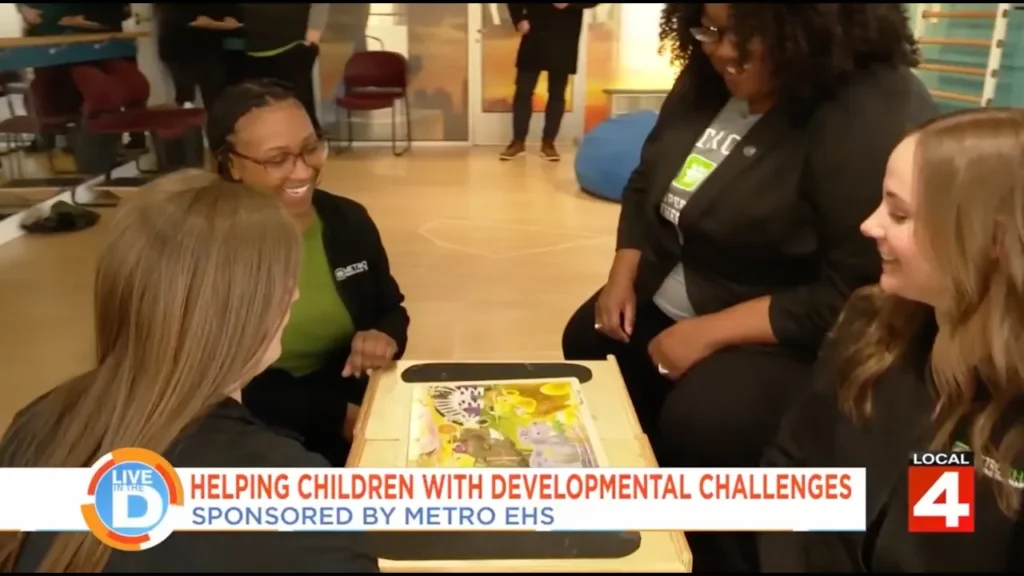
In a recent airing of Live in the D, sponsored by MetroEHS Pediatric Therapy, the spotlight was on Autism Awareness Month, shedding light on how children on the autism spectrum can benefit from life-changing therapy. MetroEHS, a pediatric neighborhood therapy company with multiple locations across Metro Detroit, including expanding services, is dedicated to enhancing the quality of life for children with various therapy needs, including autism.

Deanna Coker, a board-certified behavioral analyst, and Kris Krajewski, a speech therapist with MetroEHS, joined the show to discuss how therapy can significantly impact children’s communication skills.

Understanding Communication Challenges in Autism

Deanna explained that autism, as a developmental disability, often presents challenges in social interaction and communication. Unlike typically developing children who learn language by observing and imitating, children with autism struggle to find meaningful ways to communicate, despite their desire to do so.

The Role of Speech Therapy

Kris emphasized that speech therapy is essential for children with autism, given that communication difficulties are a hallmark characteristic of the condition. Speech therapists, like those at MetroEHS, work to identify barriers to communication and introduce alternative methods for expressing thoughts and needs.

Speech Therapy Interventions

Kris introduced an innovative tool called the AAC device (Alternative and Augmentative Communication), essentially an iPad loaded with specialized software designed exclusively for communication purposes. This device enables children to select words and icons to express themselves, giving them a voice and autonomy in their interactions.

Empowering Communication Through Tools

Deanna highlighted another communication aid, the PECS book (Picture Exchange Communication System), a low-tech solution that uses pictures to help children convey wants, needs, and preferences. By selecting and exchanging pictures, children can effectively communicate with caregivers, enhancing their independence and self-expression.

The conversation between Deanna, Kris, and the show’s host highlighted the importance of therapy in empowering children with autism to communicate effectively. Through innovative interventions and specialized tools, such as AAC devices and PECS books, children can overcome communication barriers and actively engage with the world around them.

For families seeking therapy services for their children, MetroEHS offers comprehensive support, including ABA, speech, occupational, feeding, and physical therapies. With multiple locations across Metro Detroit and additional centers on the way, MetroEHS aims to make therapy accessible and impactful for families in need.