Feeding disorders are very common. Though it is hard to quantify, “[a]pproximately 20-50% of normally developing children, and 70-89% of children with developmental disabilities” (1) have a feeding disorder. How does this happen so frequently?!
According to Dr. Kay Toomey’s research and reviews of other studies, of children who have feeding disorders, between 65-95% of cases are caused by both behavioral and natural, organic causes (2017) (2). In other words, more often than not, a feeding disorder is not just behavioral! For example, a child that has undiagnosed reflux or allergies has learned to refuse food, because they have learned that food causes them to have an upset stomach. They may continue to refuse food even after receiving treatment for the initial physiological problem. A child that has choked on some solids because of undiagnosed oral dysphagia will begin to only eat liquid and purees to avoid choking. A child that is refusing crunchy foods could have sensory processing disorder and benefit from desensitization. A child that is having a hard time breathing will refuse food in order to get enough oxygen to survive. The examples could go on and on. Every child is different, and needs to be diagnosed and treated holistically.
Some signs that may indicate your child could have a feeding disorder include:
If your child eats less than 20 foods
If mealtimes take more than 30 minutes
If they refuse all of food of a certain texture or color, or are they having difficulty transitioning to solids
If they are choking, coughing, or gagging while eating
If they are demonstrating a lot of negative behaviors during meal times
If they have difficulty with mealtime routines or have a hard time sitting at the table
If they have difficulty chewing or swallowing (example: food left in their mouth after they’ve finished eating)
If you think your child could have a feeding disorder, or you feel that you’ve exhausted your options at home and don’t know where else to go, your child could likely benefit from a feeding evaluation and possibly feeding therapy. A pediatric feeding specialist can help you determine the cause, if a cause is present, make appropriate referrals, and plan the best course of treatment. Slowly, your child will become an adventurous and independent eater!
Parents often ask one important question before preschool or kindergarten begins:
"Is my child ready?"
Many people think school readiness simply means knowing letters, numbers, or colors. While those skills are certainly helpful, they are only one small piece of the puzzle.
The truth is that successful classroom participation depends on many developmental skills working together.
Can your child:
✔ Follow simple directions?
✔ Transition between activities?
✔ Sit with a group?
✔ Ask for help?
✔ Play alongside peers?
✔ Manage big emotions?
✔ Hold crayons and scissors?
✔ Listen during story time?
✔ Walk safely in a classroom?
These everyday abilities often have a much bigger impact on classroom success than academic knowledge alone.
Why School Readiness Matters
The first few years of school help shape confidence, friendships, communication, and lifelong learning habits.
When children enter school with strong foundational skills, they're often able to:
Participate confidently
Build friendships
Follow classroom routines
Learn alongside peers
Become more independent
For children with autism, these foundational skills often benefit from early, coordinated support.
Introducing Superhero Academy
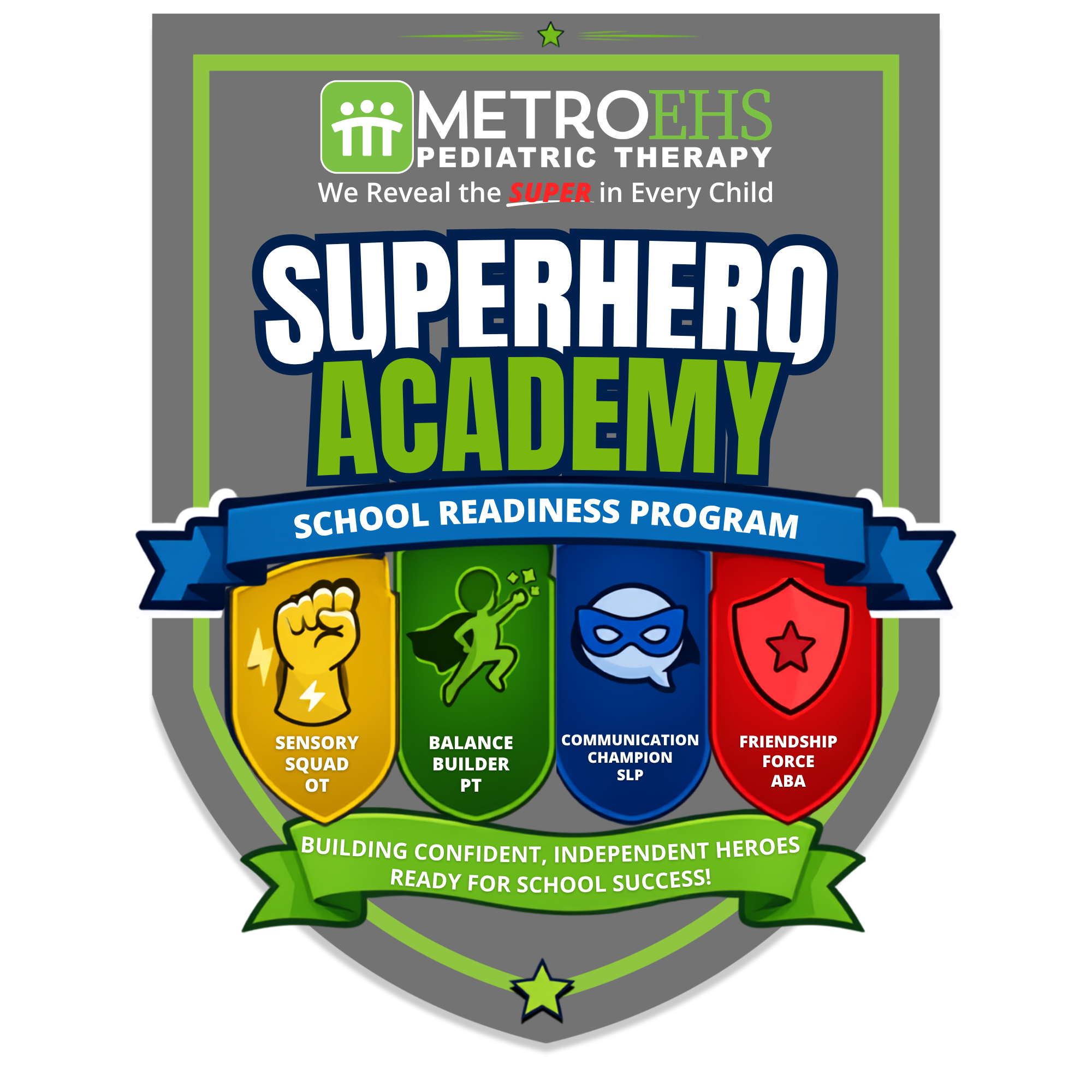
MetroEHS created Superhero Academy to help children ages 2-6 develop the skills needed for preschool and kindergarten through integrated therapy.
Unlike traditional therapy where each discipline works independently, Superhero Academy combines:
Every milestone helps prepare them for the classroom.
Celebrating Every Hero
Children earn Hero Badges as they master new skills throughout the year.
At graduation, every child receives a Superhero Cape or Hero Champion Medal and a diploma celebrating everything they've accomplished.
Because every child deserves to feel like a superhero.
Ready to Begin?
If your child is between the ages of 2 and 6 and has been diagnosed with autism and you’ve been interested in an ABA program, Superhero Academy may be the perfect next step.
Brittany: Hello! My name is Brittany, I am the bilingual Speech Pathologist at Metro EHS in Sterling Heights and Detroit.
Mallory: Hi! My name is Mallory, and I work in the Human Resources Department at the administrative office in Plymouth.
B: And we are so excited to announce that MetroEHS now offers speech therapy in Spanish and English!
M: That’s great! We can service Metro Detroit kids in their native language! But Brittany, can you tell me how to know if my child needs speech therapy?
B: Sure! If you have concerns about the language or articulation development of your child, it is possible that he/she might benefit from speech therapy. For example, if your child cannot pronounce certain sounds, does not say a lot of words or combine words to form sentences, or if you cannot understand him/her, we can do an evaluation to see if he/she qualifies for speech therapy.
M: That sounds great! What happens next?
B: After the evaluation, if therapy is necessary, we are able to initiate therapy in English, Spanish, or both languages to help your child communicate with family, friends and all of the people in the child’s life using their preferred language.
M: So cool! Are any other therapies offered?
B: Of course! We also offer therapy for feeding difficulties, stuttering, problems with social language secondary to autism, and the use of augmentative and alternative communication for children who are not able to talk using verbalizations. Here at MetroEHS we also offer occupational and behavior therapy at all of our centers. We have a phenomenal team of therapists that provide individualized services for your child. And Mallory, you can assist Spanish-speaking families get started, right?
M: Of course! We accept most insurances. I would be happy to answer any questions that families might have. Call our office to see if your child might benefit from speech therapy or other therapies in Spanish, English, or both languages. Our telephone number is 313-278-4601. We would love to talk to you!
Brittany: Hola! Me llamo Brittany y soy la terapeuta bilingue de habla en MetroEHS en Sterling Heights y Detroit.
Mallory: Hola! Me llamo Mallory y trabajo en el departamentro de recursos humanos en la oficina administrativa en Plymouth.
Brittany: Estamos emocionados de anunciar que MetroEHS ofrece la terapia de habla en ingles y espanol.
Mallory: Que excelente! Podemos proporcionar la terapia de habla a ninos en MetroDetroit en su idioma nativo. Brittany, me puedes explicar como saber si mi hijo necesita la terapia de habla.
Brittany: Por supuesto! Si tiene preocupaciones del desarrollo del lenguaje o de la articulacion de su hijo es posible que se beneficie de la terapia de habla. Por ejemplo, si su hijo no puede pronunciar ciertos sonidos, no dice muchas palabras ni combina palabras para hacer oraciones, o si no le puede entender a su hijo, podemos hacer una evaluacion para ver si califica para la terapia de habla.
Mallory: Suena muy bien! Que pasara despues?
Brittany: Despues de la evaluacion, si las terapias son necesarias, podemos iniciar las terapias en ingles, espanol o ambos idimos para ayudar a hijo a comunicarse con la familia, los amigos y todas las personas en su vida usando su idioma preferido.
Mallory: Guau(wow)! Ofrecen otras terapias?
Brittany: Tambien ofrecemos terapias para dificultades con la alimentacion, el tartamudeo, problemas con el lenguje social secundario al autismo, y el uso de comunicacion aumentativa y alternativa para ninos que no puede hablar con verbalizaciones. En MetroEHS, ofrecemos la terapia ocupacional y la terapia de comportamiento (ABA). Tenemos un equipo fenomenal de terapeutas que proporcionan servicios individualizados para su hijo. Mallory, tu puedes ayudar a las familiar que hablar espanol en la oficina, verdad?
Mallory: Por supuesto! Aceptamos muchos seguros medicos. Yo estaria encantada de responder a cualquier pregunta que tenga. Llame nuesta oficina para ver si su hijo se podria beneficiar de la terapia de habla en espanol, ingles, o ambos idiomas. El numero de telefono de la oficina es 313-278-4601. Nos encantaria hablar con usted.
A Comprehensive Guide for Parents on the Individualized Education Program
Navigating the world of special education can be overwhelming for parents, especially when faced with terms and processes that are unfamiliar but crucial for their child's education. One of the most crucial tools in supporting children with developmental needs is the Individualized Education Plan (IEP). But what exactly is an IEP, and how can it benefit your child? In this post, we’ll break down the IEP process into four essential points to help you understand how it works and how it can support your child’s educational journey. Plus, we’ll highlight how MetroEHS Pediatric Therapy leverages IEPs to providecomprehensive care for families.
1. Understanding the Basics: What Is an IEP?
An IEP, or Individualized Education Program, is a legally binding document developed for children who qualify for special education services in public schools. The child's IEP outlines specific educational goals, the services the child will receive, and the setting in which those services will be delivered. The IEP is designed to meet the unique needs of each student and is developed by a team that includes parents, teachers, school administrators, and specialists. The IEP is mandated by federal law to ensure that children with disabilities receive a free appropriate public education tailored to their unique needs.
An IEP is provided for students who are aged 3-26 in the state of Michigan. This is Part B of IDEA which is the Individuals with Disabilities Education Act, a federal law that provides free public education and special services to children with disabilities. IDEA entitles children to special education services if their disability significantly impacts their ability to access education, and if a specially designed program is needed. Part C of IDEA includes a special education law that governs special education programs and services for children who are birth to 3 years old. Special needs children in this age grouping and their families receive an Individualized Family Service Plan, and parents/caregivers are integral to the assessment and intervention process. This program is often called “Early On”.
At MetroEHS Pediatric Therapy, our specialists understand the critical role an IEP plays in a child’s education. We work closely with families and school districts to ensure that the IEP aligns with the child’s developmental goals, ensuring a smooth transition between therapy and the classroom environment.
2. The Evaluation Process: How Does It Start?
The IEP process begins with an initial evaluation with a MET (Multidisciplinary Evaluation Team). The MET only includes the required personnel for areas being assessed, which always includes a district representative, and a general education teacher in addition to other special education staff (special education teacher, speech and language pathologist, occupational therapist, and teacher consultants). This initial evaluation is a crucial step in the special education process to assess whether a child qualifies for special education services. In order to be eligible for special education programs and services, the child must have needs that pose an adverse academic impact. If your child has been diagnosed with a developmental disorder, such as autism, you should contact your local school district to request a special education evaluation. If parents disagree with the school's evaluation, they have the right to request an Independent Educational Evaluation (IEE) at the school district's expense. This request must be made in writing, as it ensures a documented trail of your efforts to seek assistance.
Once the request is made, the school district has 30 school days to complete the initial evaluation. MetroEHS is proud to assist families during this process, offering insights and support to ensure that every evaluation considers the child’s full range of needs.
3. Developing the IEP: Collaborating for Special Education Services Success
Once the evaluation is complete and eligibility is confirmed, the IEP team—including parents, teachers, and specialists—convenes for an IEP meeting to develop the IEP. During the IEP meeting, various school personnel, including teachers and administrators, collaborate to create a plan that addresses the child's unique needs. The plan outlines specific goals for the school year, the type of classroom environment the child will be placed in, and any additional services they will receive to support the child's educational development. An IEP meeting should be held at least once per year and can occur more often at the discretion of any IEP team member.
At MetroEHS, we emphasize the importance of parental involvement in this process. Parents are the experts on their child’s needs, and their input is crucial in creating an effective IEP. We work with families to ensure their voices are heard, advocating for the services and accommodations that will best support their child’s growth and learning.
4. Ongoing Monitoring and Adjustments: Keeping the IEP Relevant under the Disabilities Education Act
An IEP is not a static document; it is reviewed annually and adjusted as needed to reflect the child's educational progress and any changes in their needs. Every three years, a full reevaluation is conducted to reassess the child’s eligibility and to update the IEP accordingly. However, parents can request an IEP review at any time if they feel the current plan isn’t meeting their child’s needs. The 3 year Reevaluation may be waived, and the child’s eligibility at that time may be continued. This occurs if there is not a concern about the child’s eligibility, (e.g., the child’s condition is chronic).
MetroEHS is dedicated to ongoing collaboration with schools and families. We monitor the effectiveness of the IEP and make recommendations for adjustments when necessary. This commitment ensures that the child receives the most appropriate education and therapeutic services at every stage of their development.
MetroEHS: Your Partner in the IEP Process with a Special Education Teacher
At MetroEHS Pediatric Therapy, we are committed to helping children with developmental needs reach their full potential. We understand that the IEP is a vital tool in achieving this goal, and we work tirelessly to support families through every step of the process. From initial evaluations to IEP development and ongoing adjustments, our team is here to provide the expertise and advocacy needed to ensure your child’s success in school and beyond.
The best start for your child is for a family member or caregiver to contact their local school district to get the IEP ball rolling. They can call their district’s special education department and seek an evaluation/support as needed.
The Procedural Safeguards is a document given to parents/caregivers at every special education meeting. This includes specific guidance for special education for children in Michigan. You can access this information here: State of Michigan's Website
If you’re seeking more information about the IEP process or need support navigating special education services, contact MetroEHS today. Our experienced professionals are ready to assist you in unlocking the full potential of your child’s educational journey.