Neuroplasticity: The Brain’s Superpower!

young boy dressed as a superhero Albert Einstein

Calling All Brain Boosters and Therapy Sidekicks!

Did you know your child’s brain has a superpower? That’s right — it’s called neuroplasticity, and it’s basically the brain’s way of saying, “Hey, I can grow, change, and level up — just give me a reason!”

In the world of pediatric therapy, neuroplasticity is our superhero ally. It means that with the right kind of training and enough repetition, a child’s brain can form new pathways, build stronger connections, and unlock abilities they never thought possible. And guess what fuels this superpower?

Intensive Intervention!

Due to a child’s neuroplasticity, MetroEHS ensnares this rapid growth acceleration by declaring Intensive Intervention as the most effective strategy in revealing the SUPER in every child. We’re talking 5 sessions a week, not because we’re trying to break a record — but because that’s how we build real, lasting change.

Think of it like superhero training camp. If your goal is to fly, shoot webs, or develop super speed, do you practice once a week and hope for the best? Nope! You train every day, building your skills and flexing those brain muscles!

Here’s why 5x a week is a power move:

  • More reps = stronger brain connections
  • Faster progress = more confidence
  • Consistent practice = real-world impactSo, when a child engages in therapy intensively and regularly, they’re not just “working hard” — they’re giving their brain the super fuel it needs to thrive. Whether it’s building communication skills, mastering motor movements, or learning how to regulate emotions, frequent sessions give the brain the boost it needs to rewire and rise to its fullest potential.“With great [brain] power comes great responsibility!” And we believe in giving kids every opportunity to grow into their best, brightest, most confident superhero selves. Ready to suit up and supercharge those neural pathways? Let’s go!

Continue Reading

January 27, 2025

How Does Early Intervention Therapy Help Children?

Greetings, fellow guardians of childhood! Today, we embark on an epic quest to uncover why early intervention in pediatric therapy is the ultimate secret weapon in the battle for our little heroes’ futures. Grab your capes, as we delve into the extraordinary world of neuroplasticity!

What is Neuroplasticity?

Imagine your brain as a high-tech superhero headquarters, constantly adapting and evolving with every new challenge and adventure. Neuroplasticity is the brain’s superpower that allows it to reorganize itself by forming new neural connections throughout life. This means that even if our tiny champions face developmental hurdles, with the right support and early intervention, their brains can reroute and expand like an elastic superhero — ready to tackle any villain that stands in their way!

The Sidekick Advantage: Why Early Intervention is Key

Just like every superhero has a trusty sidekick, children thrive when they receive early intervention in therapy. Research shows that the earlier kids receive therapeutic services, the more they can harness the powers of neuroplasticity to strengthen their skills, build resilience, and achieve their personal goals. Waiting too long can mean allowing obstacles to grow larger than life, much like letting a villain strengthen their force field!

Fighting Supervillains: Common Developmental Challenges

From speech delays, motor skill challenges to difficulties in feeding, utilizing early intervention means therapists swoop in like The Flash, delivering focused support to help children navigate these hurdles. With specialized tactics, our tiny heroes can battle their challenges and emerge triumphant, all whilst building confidence and unlocking their hidden potential!

The Dynamic Duo: Parents and Therapists Unite!

In this superhero tale, parents are the ultimate allies, teaming up with skilled therapists to devise personalized action plans tailored to each child’s unique needs. The synergy created by early intervention turns this duo into an unstoppable force—ready to level up skills in communication, socialization, and physical abilities. Together, they create a supportive environment where our little champions can flourish!

MetroEHS prioritizes early intervention in pediatric therapy because it isn’t just best practice; it’s a superhero saga ready to unfold with amazing successes! Using the incredible force of neuroplasticity, our little ones can script a future filled with hope, happiness, and triumph.

June 17, 2022

What Is the TheraSuit Method and How Does It Help Children Build Motor Skills?

History of TheraSuit

Richard and Izabela Koscielny are physical therapists, who have a daughter diagnosed with cerebral palsy and tried out suit therapy with her. After significant improvements with the suit, they modified and created their own suit specialized for therapeutic benefits, called TheraSuit™.

How Does TheraSuit Work?

  • TheraSuit worn over a prolonged time will correct proprioception and accelerate progress with functional strengthening
  • Skills practiced become more fluent when TheraSuit is worn
  • TheraSuit facilitates the development of new gross and fine motor skills faster than typical therapy approaches

Benefits Seen with TheraSuit

  • Retraining the central nervous system
  • Restores ontogenetic development
  • Provides external stabilization
  • Normalizes muscle tone
  • Aligns the body to as close to “normal” as possible
  • Provides dynamic correction
  • Normalizes gait patterns
  • Provides tactile stimulation
  • Influences the vestibular system
  • Improves balance
  • Improves coordination
  • Supports weak muscles
  • Decreases uncontrolled movements in ataxia and athetosis
  • Improves body and spatial awareness
  • Provides resistance to muscles to further enhance strengthening
  • Improves speech production and fluency through head control and trunk support
  • Promotes gross and fine motor development
  • Helps decrease contractures
  • Helps improve hip alignment through vertical loading
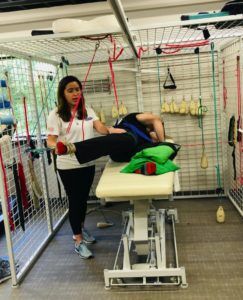
image

Patient Populations

  • Most major neurological diseases/diagnoses:
    • Autism
    • Down Syndrome
    • Cerebral Palsy
    • Cerebral Vascular Acciden
    • Traumatic Brain Injury
    • Spinal Cord Injury
  • Posture/alignment asymmetries
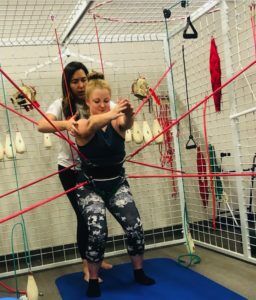
image

Intensive Physical Therapy Schedule

  • Intensive physical therapy is meant to be done 3 hours/day, for 5 days/week for 3-5 weeks
  • Recommended to complete 3-4 intensive bouts of therapy throughout the year
  • Breaks between the bouts have been shown to be more beneficial for the patient vs continuously pushing for months on end
  • Recommended to complete HEP 1-hour/day to compliment exercises done in intensive, allowing the patient to not only maintain, but improve their functional abilities
  • The schedule of 4  weeks was created specifically in order to change the neuro-pathways, and allow for increased improvements

In General

  • Week 1 works on correct muscle activation and beginning to complete basic concentric exercises
  • Week 2 works on solidifying concentric movements and working into eccentric movements
  • Week 3 solidifies the eccentric movements and introduces isometric holds
  • Week 4 focuses all on isometric holds, working into more complex exercises, as well as creating POC and HEP for time off between bouts of intensive

Work to decrease primitive reflexes and general movements that are present → goal-directed movements → selective effective strategies → refining skills → maintaining through practice

March 26, 2025

Why Is Early Intervention Feeding Therapy So Important for Children?

In the grand battle of dinnertime, where broccoli becomes a villain and picky eaters stage epic showdowns, there exists a team of superheroes ready to save the day—Pediatric Feeding Therapists! These mighty champions use their super skills to help babies, toddlers, and children with feeding challenges, ensuring every little hero gets the nutrition they need to grow strong.

The Origin Story: What is Pediatric Feeding Therapy?

Pediatric feeding therapy unites speech therapists, occupational therapists, and sometimes behavior analysts (yes, ABA superheroes!) to help children overcome feeding struggles. Whether it’s a sensory issue, difficulty with chewing, swallowing, or just a deep-seated dislike for anything green, these experts use science, patience, and fun strategies to turn mealtime mayhem into moments of mastery.

Many young heroes-in-training face powerful foes:

The Texture Titan – That sneaky foe who makes certain foods feel ‘icky’ or unbearable.

The Gag Goblin – The reason some kids struggle with new foods and textures.

The Avoidance Avenger – The mastermind behind food refusals and dinnertime battles.

The Autism Anomaly – Children with autism often experience heightened sensory challenges that impact eating habits.

Fear not! Early intervention in feeding therapy provides the best chance to defeat these villains before they gain strength. The sooner a child receives support, the more likely they are to develop healthy eating habits that last a lifetime.

In all seriousness, some pediatric feeding disorders are complex and often require a comprehensive approach individualized for each child and family. MetroEHS provides scheduling options dependent upon the family schedule and the severity of the diagnosis. All evaluations are performed by a Team of Feeding/Swallowing Specialists. MetroEHS Speech-Language Pathologists, Occupational Therapists, and Physical Therapists work in tandem with Parents to improve feeding and swallowing disorders.

The Power of Breastfeeding Support

For the tiniest superheroes just starting their feeding journey, breastfeeding support and lactation therapy can make a world of difference. Some babies face challenges with latching, tongue ties, or milk transfer, which can make feeding difficult and stressful for both baby and parent. Lactation consultants and feeding therapists work together to provide guidance on positioning, improving latch techniques, and addressing any underlying oral-motor issues. Early support ensures that even the youngest heroes get the nourishment they need to thrive from day one!

The Superpower of Early Intervention in Feeding Therapy

Early intervention is like unlocking a hidden superhero ability—striking before the villains take full control! The benefits of starting pediatric feeding therapy as soon as you suspect an impending battle or villainous origin story:

Building Healthy Eating Habits: Introducing a variety of foods early makes for a well-rounded diet.

Improving Oral-Motor Skills: Strengthening those tiny mouth muscles for better latch or better chewing and swallowing.

Reducing Mealtime Stress: No more dinnertime showdowns! Parents and children both enjoy a more relaxed experience.

Enhancing Independence: Teaching kids to confidently try new foods and textures on their own.

Assembling Your Feeding League

If your baby, toddler, or child struggles with eating, picky eating, or sensory issues, it’s time to call in the feeding therapy superheroes. ABA techniques, occupational therapy, and speech therapy can all work together to build confidence at mealtime.

Remember, every great hero starts somewhere and learns new skills best when they are small. With early intervention and the right team behind them, your little one can transform from a mealtime sidekick into a fearless food explorer!

Is your child ready to join the Feeding League? The adventure begins now!