What Is the TheraSuit Method and How Does It Help Children Build Motor Skills?

History of TheraSuit

Richard and Izabela Koscielny are physical therapists, who have a daughter diagnosed with cerebral palsy and tried out suit therapy with her. After significant improvements with the suit, they modified and created their own suit specialized for therapeutic benefits, called TheraSuit™.

How Does TheraSuit Work?

  • TheraSuit worn over a prolonged time will correct proprioception and accelerate progress with functional strengthening
  • Skills practiced become more fluent when TheraSuit is worn
  • TheraSuit facilitates the development of new gross and fine motor skills faster than typical therapy approaches

Benefits Seen with TheraSuit

  • Retraining the central nervous system
  • Restores ontogenetic development
  • Provides external stabilization
  • Normalizes muscle tone
  • Aligns the body to as close to “normal” as possible
  • Provides dynamic correction
  • Normalizes gait patterns
  • Provides tactile stimulation
  • Influences the vestibular system
  • Improves balance
  • Improves coordination
  • Supports weak muscles
  • Decreases uncontrolled movements in ataxia and athetosis
  • Improves body and spatial awareness
  • Provides resistance to muscles to further enhance strengthening
  • Improves speech production and fluency through head control and trunk support
  • Promotes gross and fine motor development
  • Helps decrease contractures
  • Helps improve hip alignment through vertical loading
image

Patient Populations

  • Most major neurological diseases/diagnoses:
    • Autism
    • Down Syndrome
    • Cerebral Palsy
    • Cerebral Vascular Acciden
    • Traumatic Brain Injury
    • Spinal Cord Injury
  • Posture/alignment asymmetries
image

Intensive Physical Therapy Schedule

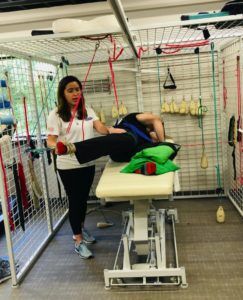
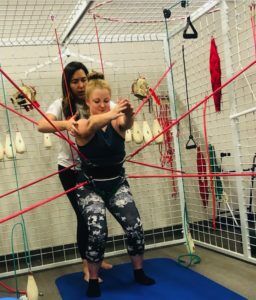
  • Intensive physical therapy is meant to be done 3 hours/day, for 5 days/week for 3-5 weeks
  • Recommended to complete 3-4 intensive bouts of therapy throughout the year
  • Breaks between the bouts have been shown to be more beneficial for the patient vs continuously pushing for months on end
  • Recommended to complete HEP 1-hour/day to compliment exercises done in intensive, allowing the patient to not only maintain, but improve their functional abilities
  • The schedule of 4  weeks was created specifically in order to change the neuro-pathways, and allow for increased improvements

In General

  • Week 1 works on correct muscle activation and beginning to complete basic concentric exercises
  • Week 2 works on solidifying concentric movements and working into eccentric movements
  • Week 3 solidifies the eccentric movements and introduces isometric holds
  • Week 4 focuses all on isometric holds, working into more complex exercises, as well as creating POC and HEP for time off between bouts of intensive

Work to decrease primitive reflexes and general movements that are present → goal-directed movements → selective effective strategies → refining skills → maintaining through practice

Continue Reading

April 30, 2020

Does Online Speech Teletherapy Work

Teletherapy, also called tele-practice or tele-speech, has become more popular during the uncertain circumstances and stay at home orders of COVID-19. Teletherapy can bring a sense of familiarity in uncertain times, as your child can have a weekly live speech therapy visit with a consistent speech language pathologist (SLP). A relationship is built, and the therapist and child share smiles and laughter in between working on their goals. With teletherapy, children can continue to receive continuity of care even as they stay safe at home! But does this foreign method of attending speech therapy really work?

Research is largely in agreement: Teletherapy is a very effective way of teaching kids speech and language!

With teletherapy, speech therapy is provided via a video chat platform that is secure. MetroEHS’s online platform includes fun games, a box for clients to watch applicable videos and talk through worksheets or read stories, screen share, practice cards, and, of course,  a live-streaming video SLP guiding them through all of it. All of these features engage most children, including those on the Autism Spectrum. This 1:1 teletherapy has been proven effective: according to a review of 7 studies of school-aged children, “telehealth is a promising method for treating children” (1). Another study looking specifically at children with ASD stated, “All [14] studies reported high levels of programme acceptability and parent satisfaction with the telehealth component of the intervention” (2). And another states, “Emerging research in telepractice treatment for ASD clients already shows success in both direct and indirect interactions” (3).

If a child is too young or difficult to engage, the SLP may opt for a parent training approach. The parent will receive a list of supplies to gather from around the house, and the SLP will teach the parent how to target the child’s goals. The parent is encouraged to ask questions, and the SLP coaches as the parent engages their child and completes their goals. This has also been proven effective for children learning language! Evidence suggests, “that parent-mediated intervention training delivered remotely can improve parents’ knowledge in [autism spectrum disorder] ASD, parent intervention fidelity, and subsequently improve the social behavior and communication skills of their children with ASD (4).

Feeding Therapy can be provided with a similar model. The SLP guides the caregiver during the session, and talks through strategies and techniques for children accepting the food, chewing, and swallowing. Providing feeding therapy online can be beneficial because the SLP can see where the child typically sits, the types of eating utensils that are used, and overall family dynamic- all of which play a major role in carryover of skills to the home environment. What better way to support generalization to home, than having therapy in the home! Feeding Teletherapy, too, is an excellent and effective substitute to in-person therapy, according to research (5)!

As you can see, teletherapy is a powerful alternative to in-person therapy, especially during situations when receiving in-person therapy is difficult or impossible for families. If you would like more information about teletherapy, to enroll your child, or a free “Teletherapy Tour” to see our platform, please contact MetroEHS today!

Resources

  1. 2017. Wales, D., Skinner, L., et al. The Efficacy of Telehealth-Delivered Speech and Language Intervention for Primary School-Age Children: A Systematic Review. International Journal of Telerehabilitation, 9(1), 55-70.
  2. 2018. Sutherland, R., Trembath, D., et al. Telehealth and Autism: A Systematic Search and Review of the Literature. International Journal of Speech-Language Pathology, 20(3), 324-336.
  3. 2015, April 28. Cornish, Nate. Social Mediating: Using Telepractice for Clients With Autism. ASHAwire.
  4. 2017. Parsons, D., Cordier, R., et al. Parent-Mediated Intervention Training Delivered Remotely for Children With Autism Spectrum Disorder Living Outside of Urban Areas: Systematic Review. Journal of Medical Internet Research, 19(8), e198.
  5. 2008. Clawson, Seldon, Lacks, Deaton, Hall, Bach. Complex pediatric feeding disorders: using teleconferencing technology to improve access to a treatment program. Pediatric Nursing, 34(3): 213-6.

Metrotherapy In Detroit, Michigan

Our therapists and educators have a passion for extending their clinical abilities to those who are in need of Special Education, Child Education or Pediatric Therapy in Metropolitan Detroit.

June 17, 2022

What Is the TheraSuit Method and How Does It Help Children Build Motor Skills?

History of TheraSuit

Richard and Izabela Koscielny are physical therapists, who have a daughter diagnosed with cerebral palsy and tried out suit therapy with her. After significant improvements with the suit, they modified and created their own suit specialized for therapeutic benefits, called TheraSuit™.

How Does TheraSuit Work?

  • TheraSuit worn over a prolonged time will correct proprioception and accelerate progress with functional strengthening
  • Skills practiced become more fluent when TheraSuit is worn
  • TheraSuit facilitates the development of new gross and fine motor skills faster than typical therapy approaches

Benefits Seen with TheraSuit

  • Retraining the central nervous system
  • Restores ontogenetic development
  • Provides external stabilization
  • Normalizes muscle tone
  • Aligns the body to as close to “normal” as possible
  • Provides dynamic correction
  • Normalizes gait patterns
  • Provides tactile stimulation
  • Influences the vestibular system
  • Improves balance
  • Improves coordination
  • Supports weak muscles
  • Decreases uncontrolled movements in ataxia and athetosis
  • Improves body and spatial awareness
  • Provides resistance to muscles to further enhance strengthening
  • Improves speech production and fluency through head control and trunk support
  • Promotes gross and fine motor development
  • Helps decrease contractures
  • Helps improve hip alignment through vertical loading
image

Patient Populations

  • Most major neurological diseases/diagnoses:
    • Autism
    • Down Syndrome
    • Cerebral Palsy
    • Cerebral Vascular Acciden
    • Traumatic Brain Injury
    • Spinal Cord Injury
  • Posture/alignment asymmetries
image

Intensive Physical Therapy Schedule

  • Intensive physical therapy is meant to be done 3 hours/day, for 5 days/week for 3-5 weeks
  • Recommended to complete 3-4 intensive bouts of therapy throughout the year
  • Breaks between the bouts have been shown to be more beneficial for the patient vs continuously pushing for months on end
  • Recommended to complete HEP 1-hour/day to compliment exercises done in intensive, allowing the patient to not only maintain, but improve their functional abilities
  • The schedule of 4  weeks was created specifically in order to change the neuro-pathways, and allow for increased improvements

In General

  • Week 1 works on correct muscle activation and beginning to complete basic concentric exercises
  • Week 2 works on solidifying concentric movements and working into eccentric movements
  • Week 3 solidifies the eccentric movements and introduces isometric holds
  • Week 4 focuses all on isometric holds, working into more complex exercises, as well as creating POC and HEP for time off between bouts of intensive

Work to decrease primitive reflexes and general movements that are present → goal-directed movements → selective effective strategies → refining skills → maintaining through practice