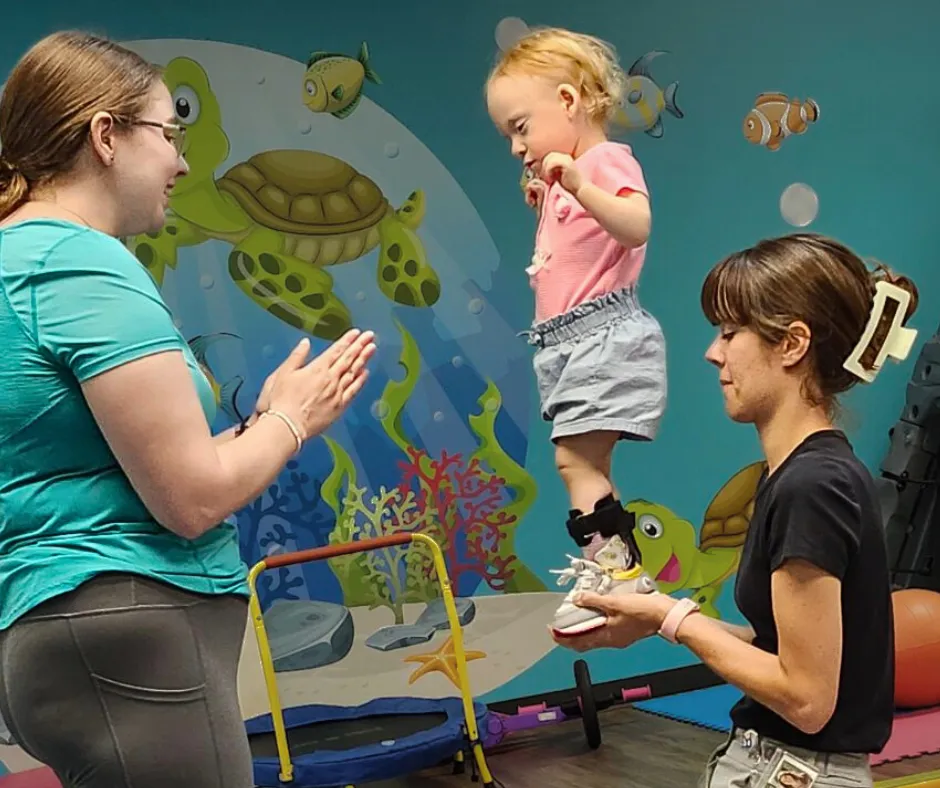









What Is Pediatric DMI Therapy and How Does It Support Motor Development?

Pediatric Dynamic Movement Intervention (DMI) therapy is a specialized treatment aimed at improving the gross motor skills, movement control, and overall functional mobility of children with developmental delays.  DMI therapy is designed to promote and enhance the natural ability of children to develop motor skills through structured, targeted interventions.

What is Dynamic Movement Intervention (DMI)?

Dynamic Movement Intervention (DMI) is a cutting-edge therapeutic approach focusing on improving strength, coordination, balance, and motor planning in children with developmental delays. DMI therapy is based on neuroplasticity principles—the brain’s ability to reorganize itself by forming new neural connections. This means that with consistent and well-targeted interventions, children with motor impairments could make significant gains in motor function.

Without disruption or intervention, unhealthy habits (the types of learned patterns of movement a child relies on rather than reflexive movements) become engrained in the child’s behavior repertoire. Neuroplasticity is defined as the ability of the brain to form and reorganize synaptic connections, especially in response to learning, experience, or following an injury. Neuroplasticity is at its height in young children. Without novelty and challenge, well-established habits always dominate. Due to this natural neuroplasticity, it is often better to start children young with any kind of therapeutic care.

The primary theory behind DMI is the use of the body's automatic postural responses.  In DMI therapy, we place the child in a position where gravity provides information requiring a response. We then wait for the child to complete the movement, with gradually less assistance over time.

Who Needs DMI Therapy?

DMI is beneficial for children with and without a specific diagnosis. However, those with specific diagnoses include, but are not limited to:

Cerebral Palsy: Children with cerebral palsy often struggle with motor control, muscle tone, and balance, all of which can be targeted by DMI therapy.

Developmental Delays: Children experiencing delays in reaching motor milestones (such as crawling, walking, or standing) may benefit from DMI’s movement-based approach.

Genetic Disorders: Certain genetic conditions that affect motor development, such as Down syndrome or muscular dystrophy, may be candidates for DMI.

Spina Bifida: This congenital condition affecting the spinal cord can cause motor deficits, and DMI can be useful in strengthening movement capabilities.

Brain Injuries: Traumatic or acquired brain injuries in children that result in impaired motor functions can be addressed through DMI therapy.

Other symptoms of a child who could benefit from DMI include:

  • Difficulty with postural control (e.g., sitting, standing, or balancing)
  • Delayed or atypical motor development (not crawling or walking at the expected age)
  • Limited muscle tone or spasticity
  • Challenges in coordination and movement precision
  • Fatigue or weakness during movement activities

This is not an exhaustive list. There are many other conditions that may benefit from Dynamic Movement Intervention. DMI therapy is typically recommended for children who have developmental motor disorders or neuromuscular challenges that affect their ability to move, balance, or coordinate their body movements.

Identifying the Need for DMI

The need for DMI therapy is typically identified by healthcare professionals such as neurologists, rehabilitation specialists or physical therapists, often after a comprehensive evaluation of the child’s motor function. Parents may also notice signs that their child is not reaching developmental motor milestones and seek medical advice.

Any physical therapy diagnosis can result in the use of DMI, and this is often very useful for children under 1 to help with head control, children under 2 to help with standing, walking, and posture control, and children 5 and under with more involved diagnoses. Early identification and intervention are extremely beneficial in maximizing the effectiveness of DMI therapy and improving the child’s functional outcomes.


Continue Reading

May 7, 2025

Unlocking Your Child’s Potential: How Early Intervention and Neuroplasticity Shape Brain Development – WDIV Segment #2

Every child’s brain is equipped with a remarkable ability known as neuroplasticity—the capacity to adapt, reorganize, and form new neural connections in response to experiences and learning. This adaptability is especially potent during early childhood, making timely intervention crucial for children facing developmental challenges, including autism spectrum disorder (ASD).

In a recent discussion, Tia Moss and Kathleen Lewandowski, Regional Discipline Directors at MetroEHS Pediatric Therapy, emphasized the significance of early intervention and the role of neuroplasticity in shaping a child’s developmental trajectory.

Understanding Neuroplasticity in Early Childhood

Neuroplasticity refers to the brain’s ability to change and adapt throughout life. In early childhood, this adaptability is at its peak, with the brain forming over a million new neural connections every second. These connections lay the foundation for essential skills such as language, social interaction, and problem-solving.

The Importance of Early Intervention

Research consistently shows that early diagnosis and intervention for autism can lead to significant improvements in communication, social skills, and overall development. Intervening during the brain’s most malleable stages allows therapists to harness neuroplasticity effectively, promoting positive behavioral and cognitive changes.

Creating an Environment That Fosters Brain Development

To optimize neuroplasticity, it’s essential to provide children with stimulating environments that encourage exploration and learning. Engaging in play, encouraging movement, and stimulating the senses can all contribute to healthy brain development . Such environments support the formation of new neural pathways, reinforcing learning and skill acquisition.

Supporting Families Through Early Intervention

MetroEHS Pediatric Therapy is dedicated to helping families navigate the journey of early intervention. Their team of professionals offers comprehensive services, including ABA therapy, speech and language therapy, occupational therapy, and more, tailored to meet each child’s unique needs.

For more information on how MetroEHS can support your child’s development, visit metroehs.com or call 248-970-8402

September 13, 2019

What Does Pediatric Feeding Treatment Look Like?

Once a child has been diagnosed with a Pediatric Feeding Disorder due to oral dysphagia or sensory processing disorder or, if diagnosed by a psychologist, ARFID (Avoidant/Restrictive Food Intake Disorder), they will likely be referred for treatment. Eating is a learned behavior. It is only instinctive for the first 6 months of life. Older children must either teach themselves, or be taught (Toomey). Treatment for a feeding disorder can be completed by a Speech-Language Pathologist (SLP), Occupational Therapist (OT), Board-Certified Behavior Analyst (BCBA), Dietician, or Psychologist. All of these disciplines have overlapping and unique approaches to treatment, so a Pediatric Feeding team that involves more than one specialist may be best for your child. As an SLP who is part of a feeding team that involves an OT and BCBA, some approaches to treatment that I utilize alongside the team include the Food Chaining Approach, The Sequential Oral Sensory approach (SOS), and the Escape Extinction approach.

Food Chaining has become recently popular due to a book written by Fraker and Cox called Food Chaining: The Proven 6 Step Plan To Stop Picky Eating, Solve Feeding Problems, and Expand Your Child’s Diet. To summarize this approach, clinicians and parents would “chain” from food that children currently enjoy by changing 1 aspect of the food at a time: either color, texture, flavor, or shape. For example, if a child enjoys cheetos, you might “chain” to orange veggie sticks (changing flavor), then to green veggie sticks (change in color), then to green veggie chips (change in shape), then to zucchini cut in a circle and placed on the chip (change of texture), then remove the chip. The child is now eating zucchini, and it was introduced slowly in a non-threatening manner! In this procedure, food is not forced on children- they are able to touch and explore it themselves, the clinician models eating it, and children are encouraged to take a bite, but they decide if they would like to try it or not. Using food chaining, children will slowly and positively increase their repertoire of acceptable food.

The Sequential Oral Sensory (SOS) approach was developed by Dr. Kay Toomey, a psychologist who specializes in Pediatric Feeding Disorders. This procedure includes another slow process of children having repeat exposures to foods prior to being forced to take a bite. For example, a child would tolerate a new food, let’s say apple slices, on their plate without expectation of eating it. Once that is tolerated, the apple will slowly and systematically move closer to their mouth, again without expectation of eating. They will touch it first with a fork or toy, then their hand, then put it on their arm, then their cheek, then kiss it, then lick it, then take a bite and spit it out, then chew, and finally swallow the apple slice. This could take a couple of days or even weeks. The idea is to allow children to have positive interactions with the food so that eating is enjoyable and they control what is placed in their mouth according to their comfort level. Eventually the child will be able to more quickly and independently follow the above steps with a new food to independently increase their diet. Children will gain confidence and learn that new foods aren’t as scary as they once thought.

The Escape Extinction approach is an effective, evidence based approach used to aid with feeding problems across all ages and is often utilized in ABA therapy by a BCBA or Behavior Technicians under the guidance of a BCBA. Eating novel food items and non-preferred food items is broken down into easier steps to aid your child with succeeding in their feeding journey. Keeping the presentation of bites and the bite sizes predictable decreases anxiety and allows the child to feel more in control during meal times. We never move up in bite size until we are certain your child is able to handle the bite at that size and has the skills needed to properly lateralize the food item, masticate the bite, and take consecutive bites. Furthermore, this approach reinforces appropriate feeding behavior while extinguishing inappropriate or disruptive feeding behaviors by not allowing the child to escape from taking bites by using a non-removal of the spoon. Often times, children will spit out food, swallow food without chewing, pack bites, turn head away from the bite, or engage in aggression. When these behaviors occur, we do not remove the bite from their lips until the bite has been taken, and provide prompts and reinforcement for taking bites and chewing appropriately.

Children enrolled in the feeding program Metro EHS Pediatric Therapy are evaluated and treated as unique individuals, so these approaches, along with others, are often combined to best help your child experience success with eating.

Sources

  1. Tooomey, Kay. SOS Approach To Feeding.
  2. Tarbox, J and Tarbax, C. Training Manual for Behavior Technician Working with Individuals with Autism Spectrum Disorder. Retrieved from Sciencedirect.com.
  3. Fraker, Fishbein, Cox, Walbert. Food Chaining: The Proven 6 Step Plan To Stop Picky Eating, Solve Feeding Problems, and Expand Your Child’s Diet. Da Capo Lifelong Books.
March 26, 2024

What Is Pediatric Pelvic Floor Therapy and How Does It Help Children?

MetroEHS introduced Pelvic Floor Therapy last month and this new therapy will change the lives of countless children because of it. Pelvic floor therapy is a specialized field of physical therapy that focuses on treating conditions and symptoms related to the pelvic floor muscles in children.  Pelvic Floor Therapy involves training your child on how to contract and relax the pelvic floor muscles and with retraining and regular exercises, your child can learn how to better control and gain sensory awareness of these muscles, which play a crucial role in urination and stooling.

Who Could Benefit from Pelvic Floor Therapy?

Pelvic floor therapy can be beneficial for children who struggle with or are unable to gain control over their bowel and bladder. This therapy is often recommended for children who are diagnosed with one or multiple of the following conditions:

  • Enuresis/Bedwetting
  • Constipation
  • Incontinence
  • Overactive bladder
  • Urinary frequency/retention
  • Urinary incontinence
  • Urinary urgenc
  • Frequent UTIs

What to Expect with Pelvic Floor Therapy?

The success of pelvic floor therapy often depends on the involvement and commitment of parents or caregivers. Adherence to recommended diet modifications and daily routines can greatly improve the outcomes of this therapy. At MetroEHS, our physical therapists take into account the family history and any life-changing events to tailor the therapy according to the specific needs of each child.